
The Big Story: The health equity crossroads – New data shows public expectations remain strong
“Broad momentum around health equity has slowed and faced political resistance. Yet communities still believe it should be a high priority—and they want healthcare organizations to act.”
Juneteenth lessons for healthcare
By Perri duGard Owens and Linzie Treadway
3-minute read
Juneteenth reminds us that words matter. But words alone are not enough.
The Emancipation Proclamation was one of the most consequential documents in American history. While the Proclamation declared enslaved people in Confederate states to be free on January 1, 1863, it could only be enforced where the Union had military power. The words carried extraordinary weight. But the declaration itself did not instantly make freedom a lived reality for every enslaved person. It wasn’t until June 19, 1865 – more than two years after President Lincoln issued the Proclamation – that Union General Gordon Granger rode into Galveston, Texas, and announced that enslaved people were free. For an estimated 250,000 Texans, the news of emancipation had finally arrived.
The following year, freed Black communities began commemorating June 19, both to celebrate freedom and to acknowledge the long delay between the declaration and their lived reality.
That history, and that two-year wait, teaches us an important lesson: Progress is not measured by what is declared. It’s measured by what people experience.
This lesson feels especially relevant in healthcare today. And we have the data to prove it.
What the public expects from healthcare today
Over the last year, healthcare organizations have found themselves navigating shifting expectations around how they talk about diversity, equity, inclusion, access and community health. In some cases, the language has changed to describe the same ongoing work. In others, organizations have become more cautious about saying much publicly at all.
But while on the surface language may be changing, our research suggests that, when you look deeper, public expectations are not.
In fact, fewer than half of Americans (44%) agree that the U.S. healthcare system is fair and that everyone can get the medical care they need regardless of race, gender or income, according to a recent Jarrard-Chartis survey on health equity. The public still sees a gap between the healthcare system we aspire to have and the one too many people experience.
Why health equity remains a trust issue
At the same time, people continue to expect healthcare organizations to help close that gap. More than seven in 10 Americans (71%) agree that when policy changes cause people to lose health insurance coverage, hospitals (and by extension provider organizations of all types) should do more to promote health equity and reduce disparities. It’s a heavy responsibility, but also a profound opportunity that goes to the heart of every provider’s mission.
Patients experience care, not terminology
In many ways, language has become the center of the debate. What language should organizations use? Which words carry political risk? What phrases are acceptable in today’s environment?
Meanwhile, communities remain focused on something far simpler and more urgent: their lived experience.
Patients experience care, not terminology. Communities measure outcomes, not vocabulary.
Whether an organization describes its efforts as “health equity,” “community health,” “population health” or “reducing disparities,” people ultimately judge success by these experiences:
- Are they able to access care?
- Are outcomes improving?
- Do they feel respected and heard?
- Is trust growing?
- And is quality consistent, regardless of who you are or how you look?
On that last point, our survey shows that half of people think the answer is “no.”
The answers to those questions matter far more than the labels attached to the work.
This is where Juneteenth offers a valuable reminder for healthcare leaders.
Declarations are important. Words help establish values, priorities, intent and direction. But words only have power when they are translated into lived reality.
For healthcare organizations, that means continuing to communicate clearly about the work that remains. It means helping communities understand not only what is changing, but what is not. It means demonstrating how commitments connect to measurable outcomes and showing progress over time.
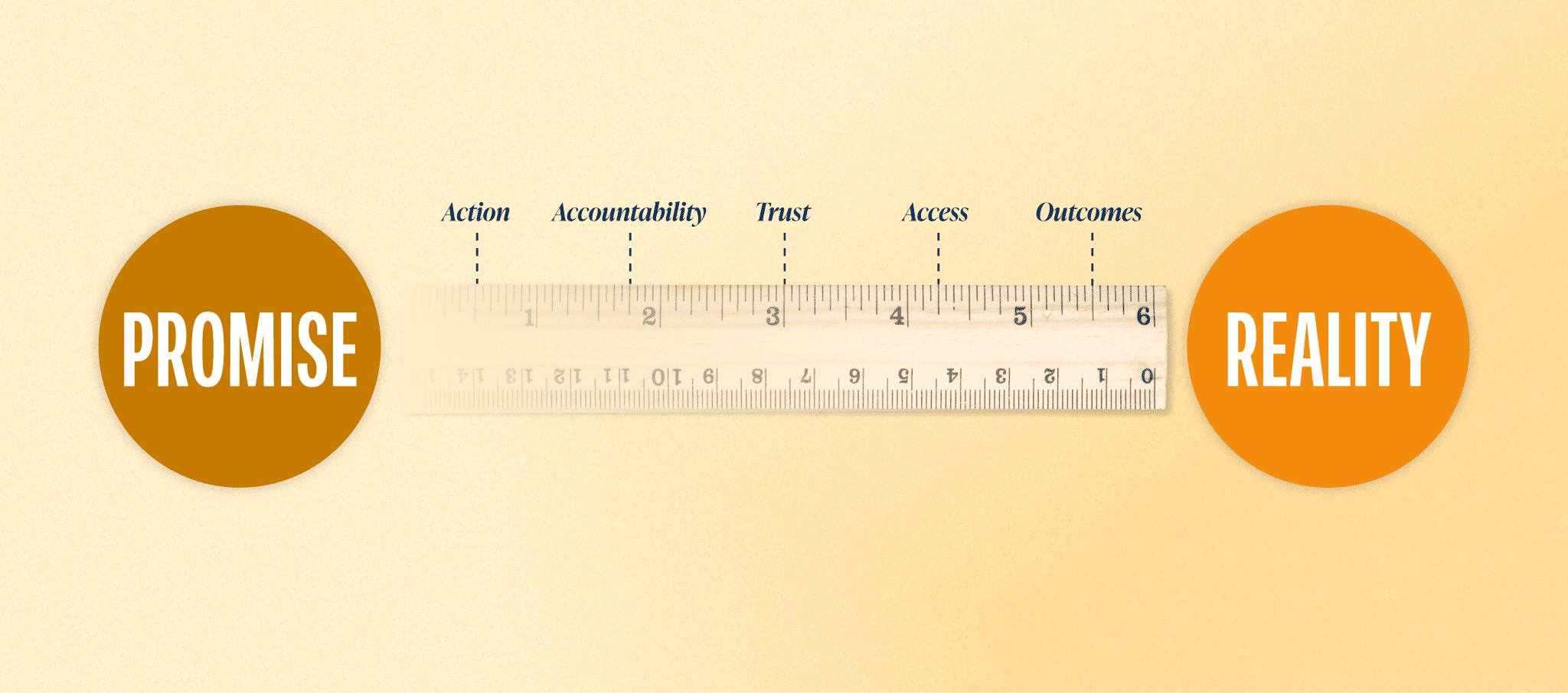
Perhaps most importantly, it means remembering that changing language does not eliminate responsibility. It must be paired with action, accountability, data-driven evidence that shows responsibility is being effectively assumed and builds sustained commitment. Because:
- The obligation to improve access remains.
- The obligation to build trust remains.
- The obligation to reduce disparities remains.
- The obligation to deliver excellent care remains.
Juneteenth reminds us that progress is not measured solely by what’s declared. It’s measured by what people experience.
Healthcare would do well to remember the same.
Contributors: Ally Carr, Kiah Calmese Walker
Image Credit: Shannon Threadgill